2026 Supercars So Far: An Unpredictable Season Heads Into Its Most Important Races
The 2026 Supercars Championship has reached the point where we can stop talking about early-season promise and start judging what this year’s contenders have actually delivered. With the Ipswich Super440 now behind us and the Sprint Cup decided, the championship has already produced changing leaders, mechanical heartbreak, breakthrough victories and enough different race winners to prevent any one driver from completely controlling the narrative.
Broc Feeney may have emerged from Ipswich with the Sprint Cup and the championship lead, but getting there has been anything but straightforward. Matthew Payne has developed into a genuine title threat, Brodie Kostecki enjoyed a formidable early run, and drivers including Cam Waters, Kai Allen, Anton De Pasquale, Chaz Mostert, Andre Heimgartner and Ryan Wood have all found ways to win.
With endurance racing coming next, let’s look at how the 2026 Supercars season has unfolded so far and why the championship remains difficult to predict.
Feeney Starts Strong, but Kostecki Answers
The season began at Sydney Motorsport Park, where Feeney immediately demonstrated why he entered 2026 as one of the championship favourites. He won the opening race and returned to the top step in Race 3, while Anton De Pasquale interrupted his potential sweep by winning Race 2.
That was already our first indication that this wouldn’t necessarily become a one-man championship. Feeney had the early advantage, but there were other drivers ready to take victories away from him whenever the opportunity appeared.
When Supercars moved to Melbourne for the Australian Grand Prix weekend, Kostecki delivered an emphatic response. He won three of the four races, taking Races 4, 5 and 7, while Feeney prevented the clean sweep by winning Race 6.
Kostecki’s Melbourne performance established another genuine championship force almost immediately. Instead of Feeney carrying his Sydney momentum into an early runaway campaign, the season suddenly had another driver capable of stringing victories together.
You can follow every result from the season on the official Supercars 2026 results page.
New Zealand Introduces Another Major Contender
The New Zealand rounds expanded the championship picture even further. Kostecki continued his impressive form by winning the opening Taupō race before Ryan Wood claimed Race 9, giving another driver his opportunity to stand on the top step.
When the championship moved to Christchurch, however, Matthew Payne began making a much stronger argument for why Penrite Racing needed to be considered among the serious 2026 title contenders. Kai Allen won Race 10, Kostecki took Race 11, and Payne claimed victories in Races 12 and 13.
Payne’s Christchurch double wasn’t simply another couple of race victories in a long championship. It represented the beginning of a period in which he increasingly looked capable of matching — and eventually surpassing — the drivers who had attracted most of the early attention.
By this stage, we weren’t simply watching Feeney versus Kostecki anymore. Payne had firmly entered the conversation.
Tasmania and Darwin Show How Competitive 2026 Really Is
If anyone still expected the championship to settle into a predictable pattern, Tasmania and Darwin quickly eliminated that idea.
Tasmania delivered three winners from three races. Chaz Mostert won Race 14, Andre Heimgartner took Race 15 and Feeney returned to victory in Race 16. The following round in Darwin remarkably produced another three different winners, with Cam Waters taking Race 17, Kai Allen winning Race 18 and De Pasquale claiming Race 19.
That meant six consecutive races across two events produced six different winners.
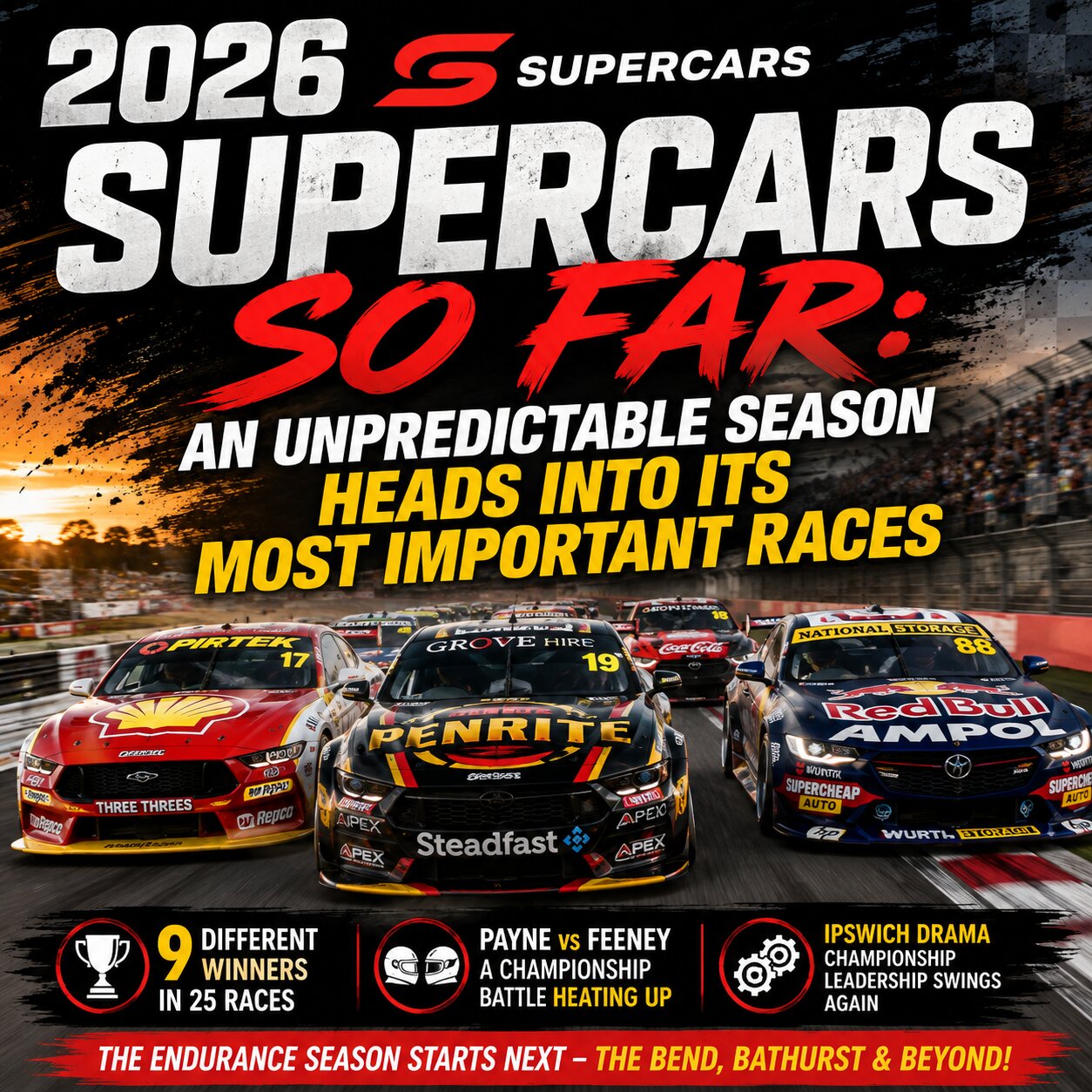
By the end of Perth, the first 25 races of the season had already produced nine different race winners:
- Brodie Kostecki
- Matthew Payne
- Broc Feeney
- Kai Allen
- Cam Waters
- Anton De Pasquale
- Ryan Wood
- Chaz Mostert
- Andre Heimgartner
That spread of winning talent is one of the best indications of how competitive 2026 has been. Payne, Feeney and Kostecki may have accumulated many of the headline results, but they haven’t been racing in isolation. There have consistently been other drivers capable of taking victories and valuable championship points away from them.
Townsville Changes the Championship Picture
Townsville became one of the most important rounds of the season, particularly for the growing battle between Payne and Feeney.
Ford machinery dominated the weekend, but the victories were shared rather than concentrated around one driver. Waters won Race 20, Payne took Race 21 and Kostecki completed the Ford sweep with victory in Race 22.
The championship consequences were even more important.
Payne had entered Townsville only 15 points behind Feeney. By the time the weekend was finished, he had taken the championship lead.
That represented an important shift in the season’s momentum. Payne was no longer merely the emerging contender who had enjoyed an excellent Christchurch weekend. He had accumulated enough strong performances to move ahead of Feeney in the championship itself.
The question then became whether he could stay there.
Payne and Feeney Go Head-to-Head in Perth
Perth gave us perhaps the clearest indication yet that Payne versus Feeney could become one of the defining battles of the 2026 season.
Payne won Race 23 before Feeney responded by taking Race 24. Race 25 then went back to Payne, who also managed an impressive on-track pass against his championship rival.
After Perth, Payne had five victories and 1,950 championship points. Feeney also had five victories but sat behind him on 1,832 points.
It was beginning to look as though Payne had taken control at exactly the right stage of the Sprint Cup. The momentum had shifted towards Penrite Racing, and Payne had proven he could fight Feeney directly rather than simply accumulating points when his rival encountered problems.
Then came Ipswich.
Ipswich Proves How Quickly Motorsport Can Turn Against You
The Ipswich Super440 was always going to be important because it represented the conclusion of the Sprint Cup and the opportunity to secure the first Golden Ticket into the Finals.
Payne entered the weekend in an enviable position after his recent run of form. Unfortunately for him, motorsport has a habit of destroying comfortable-looking championship situations remarkably quickly.
During Race 28 on Sunday, Payne suffered a mechanical failure and retired. Mostert also encountered mechanical trouble, while Feeney suddenly found himself presented with an opportunity to turn the championship situation around.
He took it.
Feeney secured the 2026 Repco Sprint Cup and emerged from Ipswich with a 30-point championship advantage over Payne.
The contrast is remarkable. Payne arrived at Townsville chasing Feeney, left Townsville ahead of him, strengthened his position through Perth and then watched that advantage disappear following a mechanical failure at Ipswich.
You can keep track of the developing standings through the official Supercars Championship hub.
Nobody Has Truly Controlled the 2026 Season
Perhaps the most interesting feature of this championship is that several drivers have appeared dominant at different moments.
Kostecki looked exceptionally difficult to beat during the opening phase of the season, particularly after Melbourne. Feeney has consistently kept himself around the championship fight and has now converted that consistency into the Sprint Cup. Payne developed from challenger into championship leader before Ipswich dramatically swung the advantage back.
Meanwhile, Waters, Allen, De Pasquale and others have repeatedly demonstrated that the leading championship contenders cannot simply assume victories when they arrive at a circuit that suits them.
Qualifying has reflected the same competitiveness. Through Perth, Payne and Kostecki had accumulated five pole positions each, Feeney had four and Waters had three. Speed has been distributed across several garages rather than belonging exclusively to one driver or team.
It means reliability and consistency could ultimately become just as important as outright speed.
Now Comes the Endurance Test
The championship is about to change character again.
The AirTouch 500 at The Bend takes place from 11–13 September before attention turns towards the biggest race on the Australian motorsport calendar, the Bathurst 1000 from 8–11 October. After Bathurst come the Gold Coast 500, Sandown 500 and Adelaide Grand Final as the championship moves towards its decisive final stages.
The remaining events and dates are available on the official Supercars calendar.
Sprint racing has shown us which drivers possess the raw pace required to win. Endurance racing introduces another collection of variables, including co-drivers, longer stints, pit strategy, mechanical reliability and the enormous pressure associated with Bathurst.
A driver who has looked brilliant over a short sprint suddenly needs his car, team and co-driver to survive a completely different challenge.
The Best Part of 2026 May Still Be Ahead
Nine different winners through the opening 25 races tells us plenty about how competitive this championship has been. What it doesn’t tell us is which of those drivers will ultimately handle the pressure best when the biggest races arrive.
Feeney currently has the advantage, but Payne has already demonstrated that he can take the championship lead from him. Kostecki has shown devastating race-winning pace, while Waters, Mostert, Allen and several others remain perfectly capable of disrupting the leading contenders when opportunities appear.
Most importantly, 2026 has repeatedly punished anyone who appears to have finally taken control.
One weekend can create a championship leader. One mechanical failure can remove that advantage just as quickly.
After everything we’ve seen from Sydney to Ipswich, predicting what happens at The Bend, Bathurst and beyond would be brave. The sprint portion of the year has given us changing momentum, nine winners and a championship battle that has already swung dramatically between its leading contenders.
If the endurance season delivers anything close to the unpredictability we’ve experienced so far, the best part of the 2026 Supercars Championship may still be ahead of us.