
Ford’s 2027 WEC Hypercar Finally Hits the Track – And That V8 Means Business
Ford Racing has finally given endurance racing fans their first proper look at the machine it intends to take into battle at the highest level of the FIA World Endurance Championship in 2027.
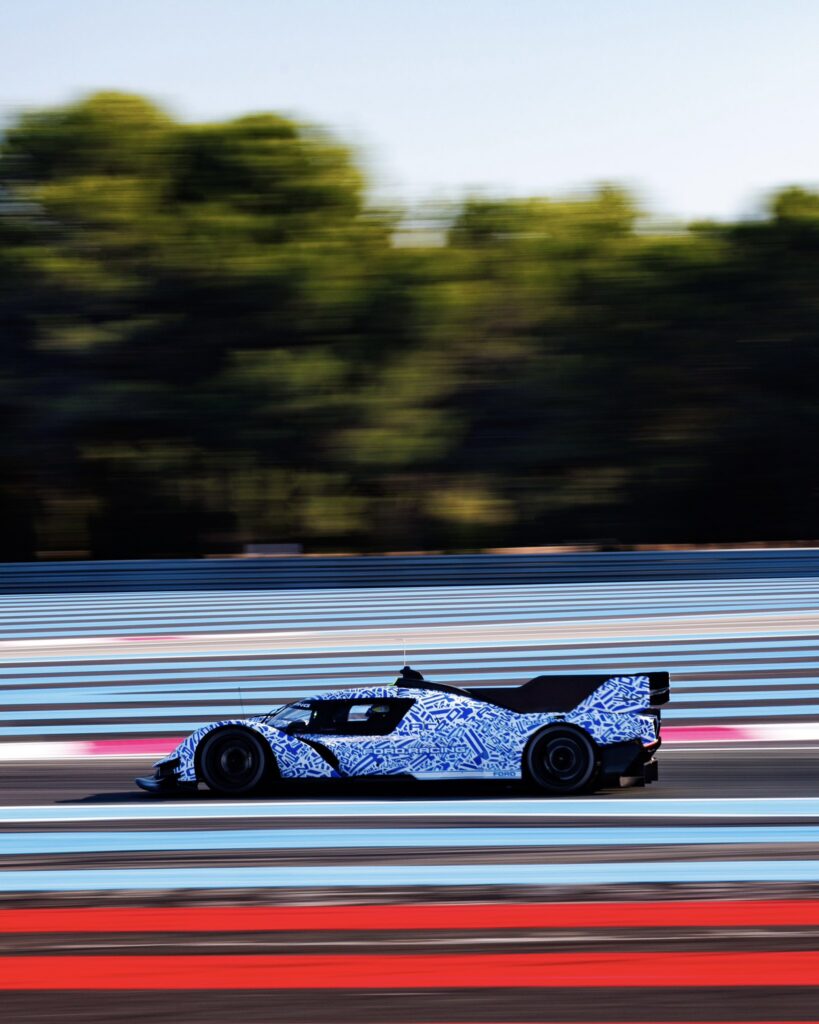
The heavily camouflaged prototype has broken cover during testing at Circuit Paul Ricard in France, giving us our first opportunity to see the proportions and aerodynamic shape of Ford’s new Hypercar in motion.
Ford isn’t simply entering another racing category, either.
This programme represents the Blue Oval’s return to the fight for overall victory at the 24 Hours of Le Mans, nearly six decades after the Ford GT40 last conquered the legendary endurance race outright.
And underneath all that camouflage sits something particularly interesting for petrolheads: a naturally aspirated 5.4-litre Coyote-based V8.
Ford Hypercar Begins Testing at Paul Ricard
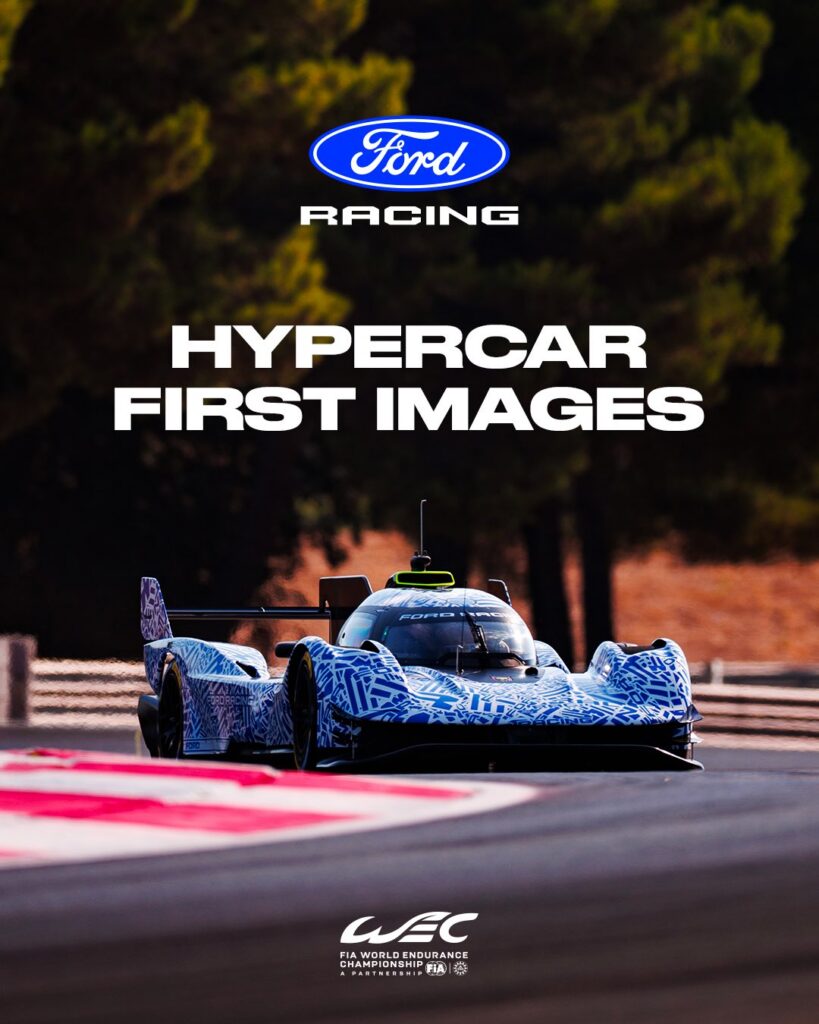
Ford Racing released the first official track images of its new prototype following testing at Circuit Paul Ricard on 17 August 2026.
The car remains covered in a blue-and-white camouflage livery, so this isn’t necessarily how the finished 2027 racer will look. Nevertheless, we can finally see the basic shape Ford will bring to the WEC Hypercar grid.
Matt Campbell and Logan Sargeant were behind the wheel for the Paul Ricard running, while Tom Blomqvist was expected to join the testing programme.
This follows an important milestone in July, when Ford announced that the engine had been fired up inside the chassis together with the hybrid system.
Now the programme has moved from dynos, simulations and workshops to the place where it ultimately matters: the racetrack.
Ford previously said its European testing programme would concentrate on reliability, performance, aerodynamics and hybrid-system integration while attempting to recreate some of the demands the car will face during the WEC and, ultimately, Le Mans.
It’s an LMDh Prototype
Although it will compete within the WEC’s Hypercar category, Ford has chosen the LMDh route for its new prototype.
Rather than designing every aspect of the chassis from scratch, LMDh manufacturers work with one of the approved chassis constructors.
Ford selected French motorsport specialist ORECA as its partner.
ORECA brings enormous endurance-racing experience to the project, including a long history of prototype development and success in LMP2.
Ford, however, isn’t treating the project as an exercise in simply placing its badge on somebody else’s racing car.
The manufacturer has been very clear that it wants significant internal involvement in the programme. Ford Racing is operating the project itself, while its engineers are responsible for one of the most exciting parts of the entire package.
The engine.
A 5.4-Litre Naturally Aspirated Ford V8
This is where things become particularly interesting.
Ford’s new Hypercar is powered by a 5.4-litre naturally aspirated Coyote-based V8, designed, developed and built in-house.
In an era where turbocharged engines have become increasingly common across high-level motorsport, Ford has gone in another direction.
There is no turbocharger required to create the personality of this machine.
Instead, we’re getting a large-capacity naturally aspirated V8 combined with the hybrid technology required by the LMDh regulations.
Ford has also deliberately created a connection between its prototype and the performance cars carrying its badge elsewhere in motorsport. The Coyote architecture provides a relationship with vehicles such as the Mustang and Ford’s GT racing programmes.
That matters because Ford wants this Hypercar to sound like a Ford.
When it eventually charges down the Mulsanne Straight in the middle of the night, there shouldn’t be much confusion about what engine is approaching.
Hybrid Technology Meets Traditional V8 Character
The new Ford demonstrates just how interesting modern endurance racing has become.
This isn’t a rejection of electrification. The LMDh platform incorporates a standardised hybrid system, meaning Ford’s naturally aspirated V8 will work alongside electric-hybrid technology.
It creates a fascinating combination.
The car brings together:
- A 5.4-litre naturally aspirated Coyote-based V8
- LMDh hybrid technology
- An ORECA-developed chassis
- Ford Racing’s own engine and control-system development
- Modern prototype aerodynamics
- A programme designed specifically to challenge for WEC and Le Mans victories
For road-car enthusiasts, that mixture is arguably one of the most appealing aspects of the programme.
Ford isn’t abandoning the sound and character associated with its performance heritage to embrace modern technology.
It’s attempting to combine the two.
Six Drivers Are Ready for Ford’s 2027 Attack
Ford has already completed its six-driver factory roster for the programme.
Logan Sargeant, Mike Rockenfeller and Sebastian Priaulx were the first drivers announced. Ford subsequently confirmed Matt Campbell, Nick Yelloly and Tom Blomqvist to complete the line-up.
There is serious endurance-racing experience among them.
Rockenfeller is an outright Le Mans winner, while Campbell, Yelloly and Blomqvist bring extensive experience across endurance racing, prototypes and major international events.
Sargeant adds Formula One experience to the development programme, while Priaulx has already established himself within Ford’s modern racing operations.
With Ford planning to enter two Hypercars in the 2027 FIA WEC, the six drivers will become central to turning the prototype we’re currently seeing in camouflage into a genuine race-winning machine.
Ford Isn’t Returning to Make Up the Numbers
Perhaps the most exciting aspect of Ford’s Hypercar programme is the attitude surrounding it.
There has been little attempt to downplay the manufacturer’s ambitions.
Ford wants to win Le Mans.
That’s significant when you consider the company’s history at the event.
The Ford GT40 famously broke Ferrari’s dominance by winning Le Mans in 1966. Ford then repeated the achievement in 1967, 1968 and 1969.
Its rivalry with Ferrari became one of the most famous chapters in motorsport history.
Ford returned to Le Mans decades later with the Ford GT and achieved a GTE Pro class victory in 2016, exactly 50 years after its first overall triumph.
The 2027 programme is different.
This time, Ford is returning to the top category.
It wants the overall trophy again.
Ford Will Face Serious Competition
Winning it won’t be easy.
The current Hypercar era has attracted some of the world’s most important performance manufacturers, creating one of the strongest periods for top-level endurance racing in decades.
Ford isn’t entering a championship where it can expect to dominate simply because of its name or history.
The programme will need reliability, speed, efficient energy management and a car capable of remaining competitive throughout races lasting six, eight or even 24 hours.
That’s why the testing we’re seeing now matters.
Every lap completed during 2026 gives Ford and ORECA more information to refine the prototype before it enters competition.
A spectacular V8 and an aggressive-looking body might excite us now.
Finishing 24 hours at Le Mans while fighting for the lead will require considerably more.
The First Look Is Only the Beginning
The camouflage makes it difficult to judge the finer details of Ford’s final design, and the prototype will undoubtedly evolve as testing progresses.
Still, seeing the machine on track transforms Ford’s Hypercar programme from an exciting announcement into something tangible.
The engine exists.
The chassis exists.
The drivers are signed.
And now the car is running.
Ford has more testing ahead before the 2027 FIA World Endurance Championship begins, but the objective has already been made abundantly clear.
The company that created one of Le Mans’ greatest racing stories is going back to the top class to try to write another one.
This time, it’s bringing a hybrid Hypercar, an ORECA chassis and 5.4 litres of naturally aspirated V8 thunder with it.
2027 suddenly feels a long way away.