
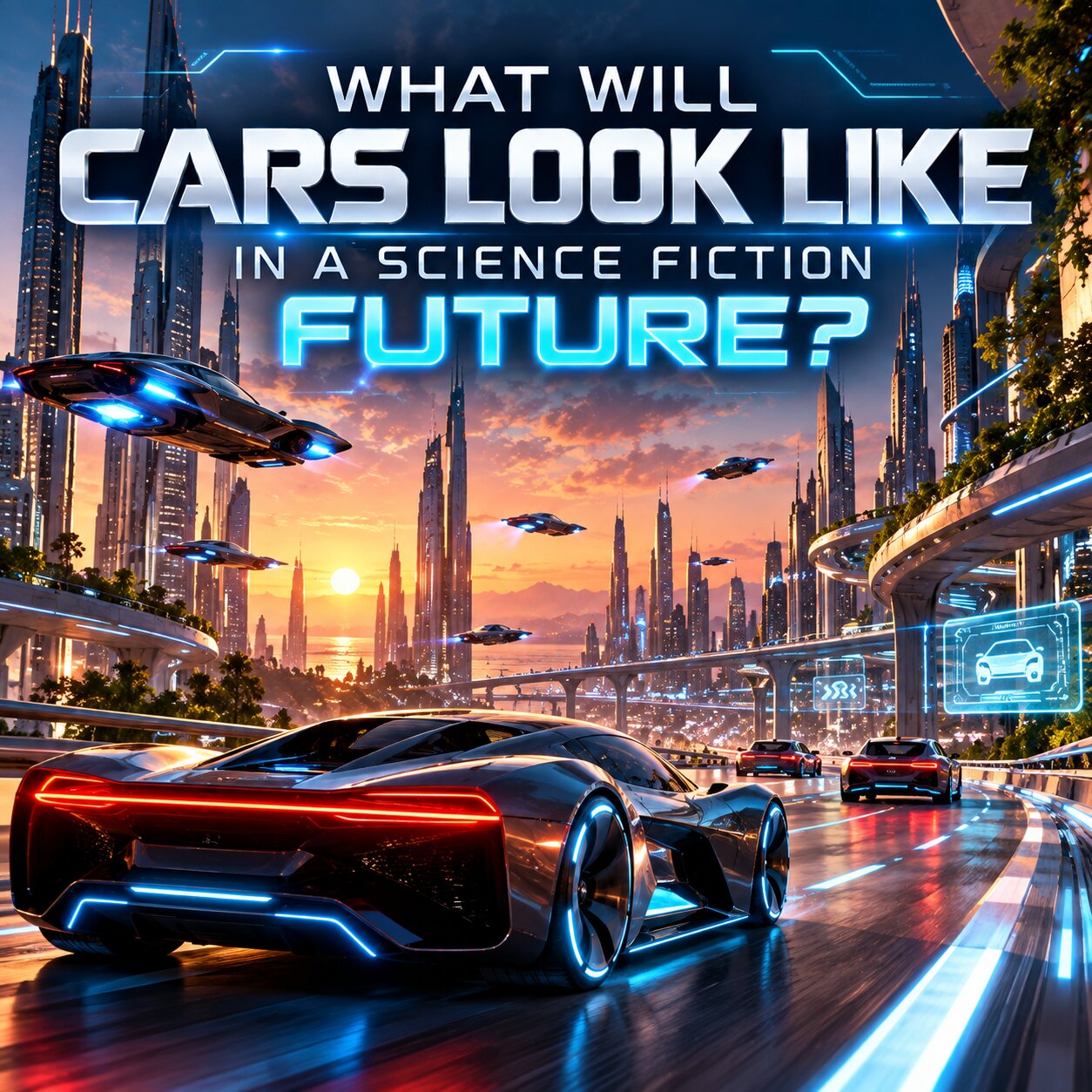
What Will Cars Look Like in a Science Fiction Future?
Science fiction has given us some spectacular visions of future transportation. Cars fly between skyscrapers, artificial intelligence handles the driving, vehicles recognise their owners and entire cities operate through interconnected transport networks.
Some of those ideas remain fantasy. Others are becoming considerably less fictional.
So, what might the car of a science fiction future actually look like?
The most noticeable difference may be what the driver doesn’t have to do. Autonomous driving technology is already being developed, and a future vehicle could potentially handle much more of the journey itself. Instead of concentrating constantly on steering, acceleration and braking, occupants might eventually become passengers for significant portions of their trips.
The dashboard could change just as dramatically.
Your Car Might Become a Computer on Wheels
Imagine a windscreen displaying navigation instructions, hazards and information through augmented reality. An AI assistant could manage routes, entertainment, climate settings and vehicle diagnostics while communicating with surrounding infrastructure.
Cars could even communicate with one another.
A vehicle approaching an accident might automatically warn cars several kilometres behind it. Traffic lights could communicate directly with approaching vehicles, while intelligent road systems adjust traffic flows before congestion develops.
Propulsion will probably undergo its own transformation. Battery-electric technology is already established, while hydrogen and other technologies continue to be explored. A sufficiently distant science-fiction setting could go much further, inventing energy systems that would make today’s combustion engine appear ancient.
Then there is the classic science-fiction dream: the flying car.
The engineering challenges are enormous. A machine capable of travelling safely on roads and through busy urban airspace would need sophisticated propulsion, navigation, regulation and safety systems. Rather than every driveway containing a flying family saloon, future cities might instead use specialised autonomous air taxis.
Our fictional future also raises interesting questions about car culture.
If vehicles eventually drive themselves, will people still enjoy driving? Will enthusiasts preserve manual sports cars much as collectors preserve classic vehicles today? Could racetracks become places where humans specifically go to experience driving for themselves?
Perhaps the future garage will contain an autonomous everyday vehicle beside a lovingly maintained petrol-powered classic reserved for weekends.
Science fiction lets us imagine everything from anti-gravity supercars to intelligent vehicles with personalities of their own. Reality will undoubtedly be less predictable.
Still, today’s technology suggests that the future car could become smarter, more connected and increasingly independent.
Whether it ever flies is another matter entirely.
Writing science fiction involving futuristic cars, strange new transportation systems or worlds beyond our own? Celenic Earth Publications welcomes fiction manuscripts for consideration. submit your sci fi book here.