How Motorcycle Slipper Clutches Work
Modern motorcycles use increasingly sophisticated technology to improve performance, stability and rider control. One particularly useful innovation is the slipper clutch, a mechanical system designed to reduce excessive engine braking during aggressive downshifts. Although commonly associated with racing motorcycles, slipper clutches are now found on many road-going sportbikes and other performance-oriented models.
Understanding how motorcycle slipper clutches work can help riders appreciate their benefits, especially when approaching corners or changing rapidly into lower gears. Unlike quickshifters, which assist with gear changes, slipper clutches primarily manage the forces transmitted between the engine and rear wheel.
What Is a Motorcycle Slipper Clutch?
A motorcycle slipper clutch is a specialised clutch assembly that limits the amount of reverse torque transmitted from the rear wheel to the engine. This reverse torque, often called back-torque, occurs when the rear wheel attempts to drive the engine faster than its current speed.
During normal acceleration, engine power passes through the clutch and transmission to the rear wheel. However, when a rider closes the throttle and selects a lower gear, the relationship between engine speed and wheel speed changes.
If the engine speed is too low for the selected gear and road speed, the rear wheel must accelerate the engine. This creates engine braking, which can become excessive during aggressive downshifts.
A slipper clutch reduces the resulting load by allowing controlled clutch slip when back-torque exceeds the system’s designed threshold.
How Motorcycle Slipper Clutches Work
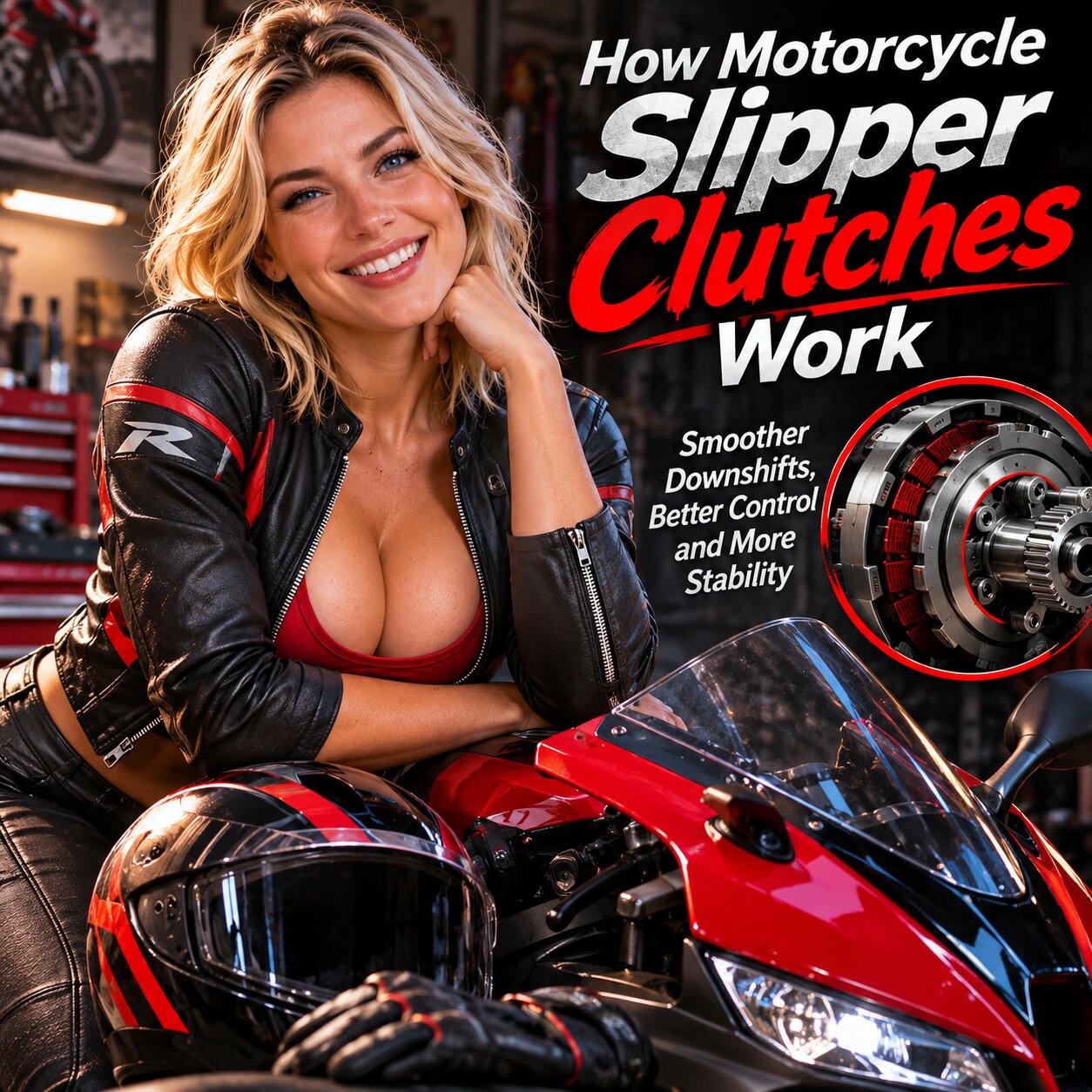
Most conventional slipper clutches use specially designed ramps, cams or similar mechanical components within the clutch assembly. These components respond to the direction and magnitude of torque passing through the transmission.
Under normal acceleration, the clutch remains engaged and transfers engine power to the rear wheel. When significant reverse torque develops during a downshift, the ramp mechanism reduces the clamping force holding the clutch plates together.
This allows the plates to slip slightly, limiting the amount of back-torque transmitted through the drivetrain. As the torque difference decreases, the clutch returns towards normal engagement.
The process occurs mechanically and does not necessarily require electronic sensors or intervention from the motorcycle’s engine management system.
Understanding Engine Braking and Back-Torque
Engine braking occurs when a motorcycle’s engine resists the rotation of the drivetrain, usually after the rider closes the throttle. It is a normal characteristic of internal combustion engines and can help control speed when approaching corners or travelling downhill.
However, excessive engine braking can become problematic when a rider downshifts aggressively. If the selected gear requires a substantially higher engine speed, the rear tyre must provide the force needed to accelerate the engine.
Under certain conditions, particularly when the rear wheel is lightly loaded during braking, this resistance can contribute to rear-wheel hopping, skidding or instability.
A slipper clutch limits the most severe back-torque effects, helping the rear wheel maintain smoother rotation during demanding downshifts.
Why Slipper Clutches Are Popular in Motorcycle Racing
Motorcycle racing places considerable demands on braking systems, tyres and transmissions. Riders frequently approach corners at high speeds before braking heavily and selecting several lower gears.
During these manoeuvres, weight transfers towards the front wheel, reducing the load on the rear tyre. Excessive engine braking can make the rear wheel more difficult to control.
Slipper clutches help manage this problem by reducing sudden reverse torque loads. This allows riders to concentrate on braking, corner entry and maintaining a stable racing line.
Although slipper clutches are particularly valuable on racetracks, their benefits can also be appreciated during spirited road riding when used responsibly.
Benefits of Motorcycle Slipper Clutches
A properly functioning slipper clutch can provide several advantages:
- Improved rear-wheel stability: Reduces the likelihood of hopping or instability caused by excessive back-torque.
- Smoother downshifts: Helps manage abrupt differences between engine and transmission speeds.
- Better corner entry control: Allows riders to concentrate on braking and steering during demanding manoeuvres.
- Reduced drivetrain shock: Limits some of the sudden loads associated with aggressive downshifting.
- Greater rider confidence: Makes certain downshifting situations more manageable, particularly on performance motorcycles.
These benefits depend on the motorcycle’s design, road conditions, tyre grip and the rider’s technique.
Slipper Clutches vs Quickshifters
Although slipper clutches and quickshifters both influence motorcycle gear changes, they perform different functions.
A quickshifter assists gear selection by briefly reducing engine torque during an upshift. Bidirectional quickshifters can also support downshifting through an electronic auto-blipper that adjusts engine speed.
A slipper clutch, by comparison, operates within the clutch assembly to limit excessive reverse torque. It does not automatically select gears or match engine speeds electronically.
Some modern motorcycles feature both technologies. In these cases, the quickshifter or auto-blipper assists with the gear change, while the slipper clutch provides an additional mechanical safeguard against excessive back-torque.
The systems complement one another but are not interchangeable.
Do Slipper Clutches Replace Proper Downshifting Technique?
A slipper clutch can make aggressive downshifts more forgiving, but it does not eliminate the need for correct riding technique. Selecting an inappropriate gear at excessive road speed can still cause mechanical damage or destabilise the motorcycle.
Riders should continue to use smooth clutch control and appropriate gear selection. Rev-matching can also remain beneficial, depending on the motorcycle’s transmission and electronic equipment.
Importantly, a slipper clutch cannot compensate for poor tyre grip, excessive corner entry speed or inappropriate braking inputs.
It should therefore be viewed as a supporting technology rather than a replacement for rider skill.
Do All Motorcycles Have Slipper Clutches?
Slipper clutches are increasingly common on sportbikes, performance-oriented naked motorcycles and some touring and adventure models. However, they are not standard equipment across every motorcycle category.
Manufacturers may describe similar systems using terms such as assist-and-slipper clutch. These designs combine back-torque limiting with an assist mechanism that increases clutch clamping force under acceleration, potentially allowing lighter clutch lever operation.
Not every assist clutch includes slipper functionality, so riders should check the manufacturer’s specifications.
Older motorcycles and models without factory-fitted slipper clutches may sometimes accommodate aftermarket systems, although compatibility and professional installation are important considerations.
Maintenance and Potential Problems
Slipper clutches contain mechanical components that experience normal wear over time. Clutch plates, springs, ramps and associated parts may require inspection or replacement according to the manufacturer’s maintenance schedule.
Symptoms of potential clutch problems include unexpected slipping during acceleration, unusual noises, inconsistent engagement or difficulty transferring engine power.
However, controlled slipping during significant back-torque events is part of normal slipper clutch operation and should not automatically be interpreted as a fault.
Using the correct engine oil, maintaining proper clutch adjustments where applicable and following manufacturer servicing recommendations can help preserve reliable performance.
Are Motorcycle Slipper Clutches Worth Having?
For riders who frequently encounter demanding downshifting conditions, a slipper clutch can be a valuable addition. Its ability to limit excessive engine braking helps improve rear-wheel stability and can make corner entry more predictable.
Everyday commuters may notice fewer benefits, particularly when riding smoothly at moderate speeds. Nevertheless, the technology provides an additional measure of mechanical control during situations where abrupt downshifts could otherwise unsettle the motorcycle.
Ultimately, understanding how motorcycle slipper clutches work reveals how a relatively simple mechanical principle can contribute to safer, smoother and more controlled riding.