McLaren Reveals New Brand Identity Connecting Its Past, Present and Future
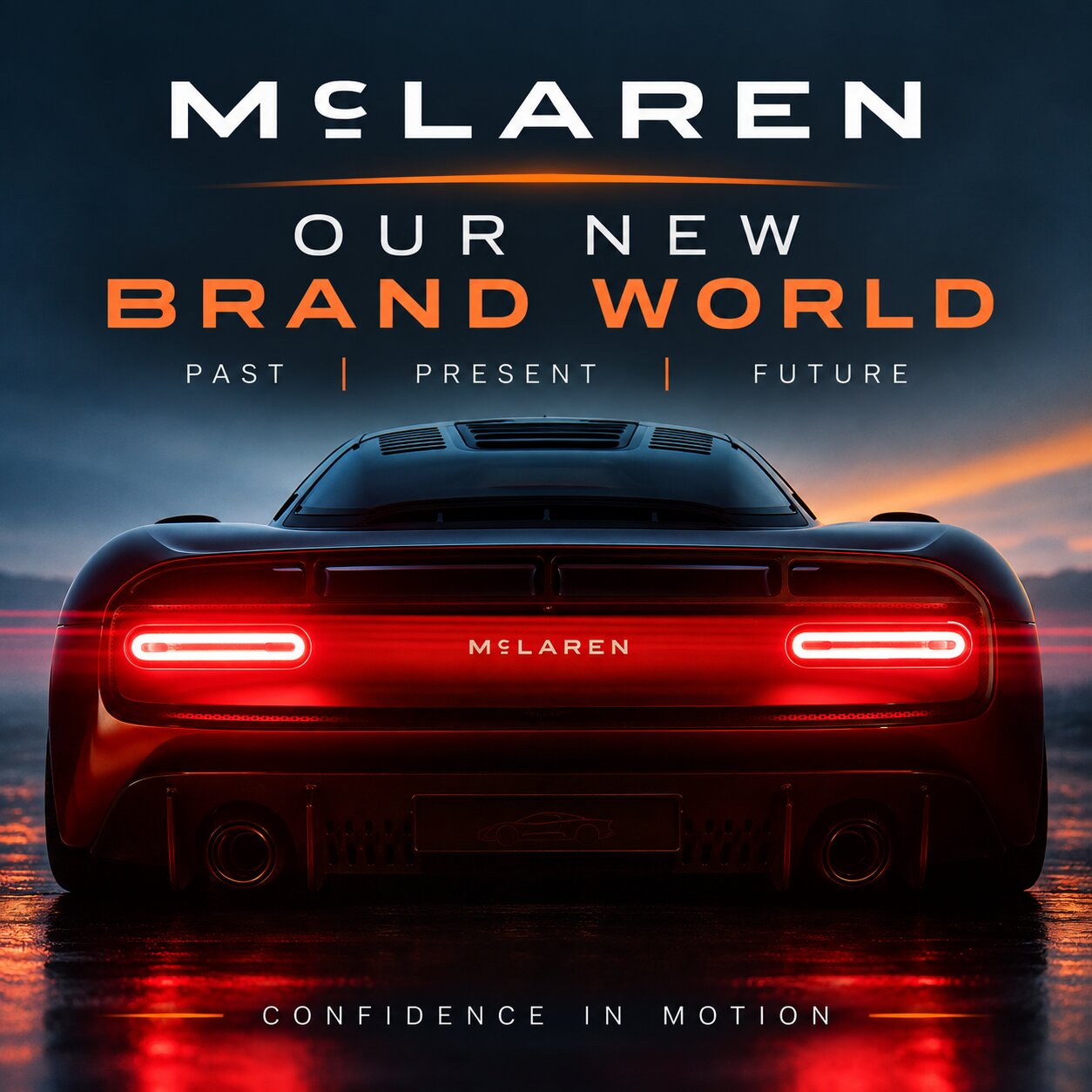
McLaren has unveiled a new global brand identity, bringing McLaren Automotive and McLaren Racing together through a design inspired by the company’s remarkable history.
McLaren has entered a new chapter with the reveal of its refreshed brand identity, designed to connect the company’s past, present and future across both its automotive and motorsport operations.
Rather than simply changing a logo, McLaren describes the project as a new “brand world”. It introduces an updated wordmark, an expanded colour palette and renewed emphasis on historic symbols that stretch back to Bruce McLaren and the company’s New Zealand origins.
The result is an interesting mixture of heritage and modernisation. While McLaren continues to position itself at the cutting edge of performance, it is also looking much further back into its history for inspiration.
A New McLaren Wordmark Inspired by Its Origins

One of the most noticeable changes is the new McLaren wordmark.
Its inspiration predates the supercars and Formula 1 machines for which the name is now famous. Before McLaren became an internationally recognised automotive and racing brand, the family name appeared above a service station in Remuera, New Zealand.
McLaren says those original letterforms provided inspiration for its new wordmark, which reinterprets them for the modern company.
That connection is particularly fitting considering the story of founder Bruce McLaren. Born in Auckland, New Zealand, Bruce went on to establish Bruce McLaren Motor Racing in 1963 before building a legacy that would become inseparable from international motorsport.
The redesigned identity therefore isn’t abandoning McLaren’s past in pursuit of something entirely new. Instead, the company is using that history as the foundation for its next era.
The Famous McLaren Speedmark Remains
Fans worried about losing one of McLaren’s most recognisable modern symbols can relax.
The familiar speedmark remains an important part of the identity.
Its retention provides continuity between the previous McLaren branding and the new visual system. Over the years, the sweeping symbol has become instantly associated with McLaren’s road cars, racing programmes and pursuit of performance.
Other historical symbols are receiving renewed attention too.
The Heritage Shield and Speedy Kiwi both feature within the expanded identity, drawing directly upon Bruce McLaren’s New Zealand roots and the earliest years of the organisation.
The Speedy Kiwi is particularly significant. Variations of the kiwi appeared on early McLaren racing cars before the company developed the visual identities recognised by modern motorsport fans.
Bringing it back into the wider brand world gives McLaren another way of celebrating that history without turning its primary identity into a retro design.
Papaya Remains at the Heart of McLaren
Then, of course, there’s papaya.
Few colours have become as closely associated with a motorsport organisation as McLaren’s famous orange.
Bruce McLaren’s racing machines adopted the distinctive shade during the 1960s, and papaya eventually returned as an important part of McLaren’s modern motorsport identity.
It isn’t going anywhere.
Instead, McLaren has expanded the colours surrounding it. The new palette draws inspiration from significant places, materials and moments throughout the company’s history.
That gives designers considerably more freedom while allowing papaya to remain the colour most immediately associated with McLaren.
McLaren Automotive and Racing Under One Identity
Perhaps the most important element isn’t an individual logo or colour.
McLaren’s new identity has been developed as one connected expression encompassing both McLaren Automotive and McLaren Racing.
That strengthens the relationship between the company’s road-going supercars and its extensive motorsport heritage.
McLaren’s road cars have always benefited from the company’s racing reputation, but bringing the two sides together more deliberately creates opportunities for stronger connections between racing fans, supercar enthusiasts and McLaren owners.
The company says its new brand world is intended to create richer community experiences, including greater personalisation and new ways for people to interact with McLaren.
More Than Just a New McLaren Logo
Automotive rebrands can sometimes amount to little more than simplifying a badge and changing a corporate typeface.
McLaren’s approach appears considerably broader.
Its new identity incorporates:
- A redesigned McLaren wordmark inspired by the family’s original New Zealand service station
- The continued use of the established McLaren speedmark
- Greater prominence for the historic Heritage Shield and Speedy Kiwi
- Papaya remaining a defining McLaren colour
- An expanded colour palette inspired by the company’s history
Together, these elements give McLaren more visual tools without removing the symbols its fans already recognise.
McLaren Looks Back to Move Forward
McLaren has undergone extraordinary changes since Bruce McLaren founded his racing organisation more than six decades ago.
The name has appeared on championship-winning racing cars, pioneering supercars and some of the most technologically advanced performance vehicles produced.
Its latest transformation doesn’t attempt to rewrite that history.
Instead, McLaren is placing it front and centre.
By drawing inspiration from a New Zealand service station, retaining the modern speedmark, celebrating the Speedy Kiwi and keeping papaya firmly within its identity, the company is connecting several generations of McLaren under one visual language.
For a brand built around moving quickly, McLaren has found an interesting way forward: remembering exactly where it started.