Emergency Vehicle Types | A Detailed Guide
Emergency vehicle types play a critical role in responding to incidents where speed, safety, and precision are essential. From medical emergencies and fires to law enforcement operations and disaster relief, these specialised vehicles are designed to handle high-pressure situations across a wide range of environments.
Understanding different emergency vehicle types helps highlight how each one contributes to public safety. Each category is built with specific tools, features, and capabilities to respond effectively to different types of incidents.
In this article, we explore the main emergency vehicle types, how they are classified, and the roles they play in modern emergency response systems.
The Role Of Emergency Vehicle Types In Public Safety

Emergency vehicle types form the backbone of rapid response systems used by governments and emergency services. Their primary purpose is to reach incident locations quickly, provide support, and help manage situations before they escalate further.
Medical response vehicles are often the first to arrive at emergencies involving injury or illness. They provide immediate care and transport patients to healthcare facilities. Fire rescue vehicles respond to fires, accidents, and rescue operations, often operating in dangerous and unpredictable conditions.
Law enforcement vehicles support policing efforts, ensuring order is maintained and incidents are handled efficiently. These vehicles are designed for mobility, communication, and rapid deployment across urban and rural environments.
Disaster relief and hazard control vehicles extend these capabilities further. They are used in large-scale emergencies such as floods, industrial accidents, and environmental hazards, ensuring coordinated and effective response efforts.
How Emergency Vehicle Types Are Classified

Emergency vehicle types are classified based on their specific functions and the type of incidents they are designed to handle. Each category focuses on a particular area of response, supported by specialised equipment and trained personnel.
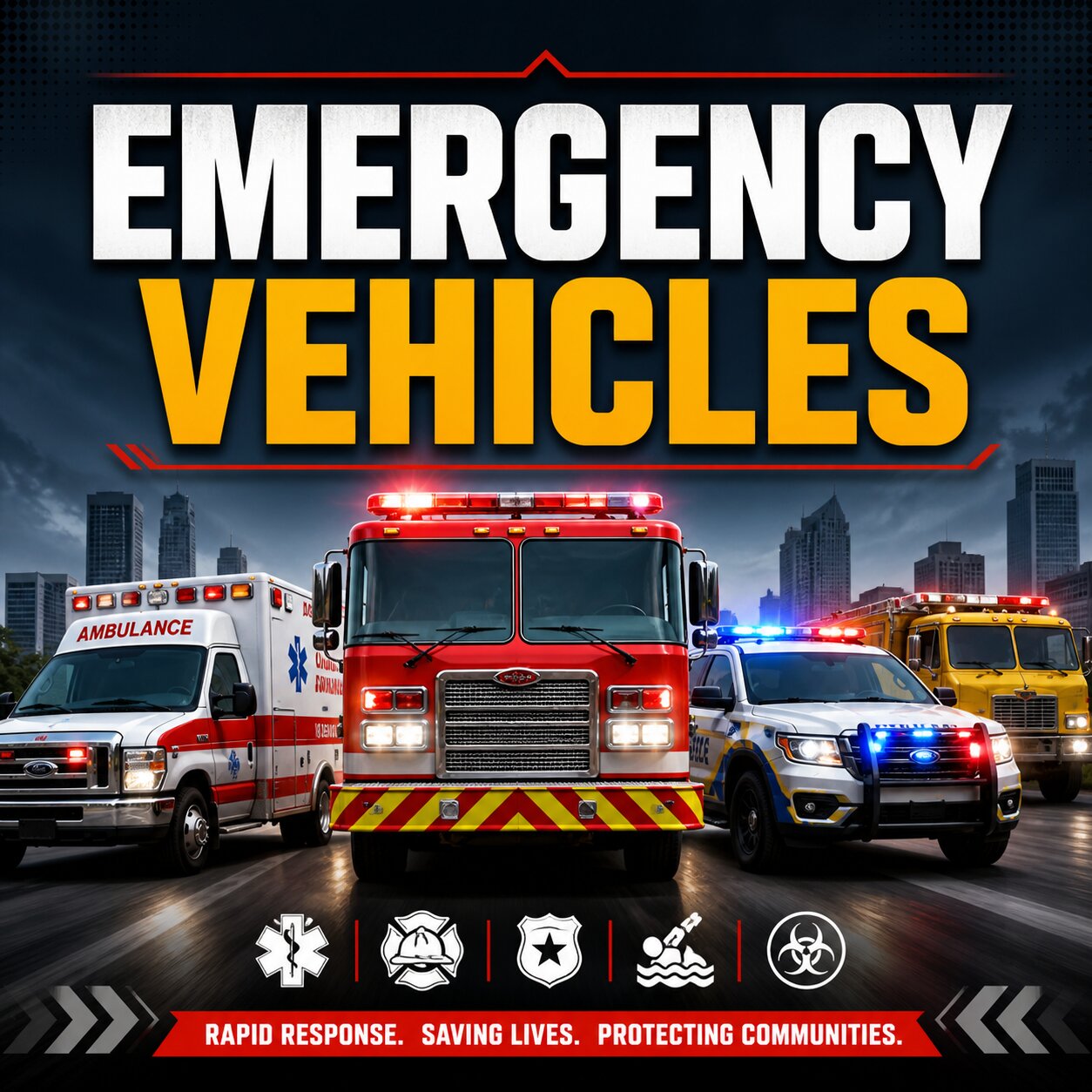
Medical response vehicles include ambulances, rapid response units, and air ambulances, all equipped with life-saving medical technology. Fire rescue vehicles range from fire engines and ladder trucks to specialised rescue units designed for complex operations.
Law enforcement vehicles include patrol cars, tactical response units, and specialised transport vehicles used for various policing tasks. Disaster relief vehicles are designed for large-scale operations, often equipped for transporting supplies, personnel, and equipment into affected areas.
Hazard control vehicles focus on managing chemical, biological, and environmental risks. These units are equipped with containment systems, protective gear, and monitoring technology to safely handle dangerous situations.
Common Emergency Vehicle Types
There are several key emergency vehicle types used across modern response systems, each serving a unique and essential function:
- Ambulances and medical response units
- Fire engines and rescue vehicles
- Police and law enforcement vehicles
- Disaster relief and support vehicles
- Hazard control and hazmat units
- Search and rescue vehicles
Each of these emergency vehicle types is designed to address specific challenges. Together, they create a coordinated response network that can handle a wide range of emergencies efficiently.
Technology Shaping Emergency Vehicle Types

Technology has transformed how emergency vehicle types operate, making them faster, safer, and more effective. Modern systems now focus heavily on communication, navigation, and real-time data.
Many emergency vehicles are equipped with GPS tracking and route optimisation tools that help responders reach incidents as quickly as possible. These systems also allow central control units to monitor vehicle movements and coordinate multiple teams during complex operations.
Advanced safety features, such as reinforced structures, high-visibility lighting, and integrated warning systems, improve both responder safety and public awareness. These enhancements are essential when operating in high-risk environments.
Looking ahead, automation and connectivity are set to play a bigger role. Autonomous emergency vehicle types and AI-assisted dispatch systems are being developed to further improve response times and efficiency.
The Future Of Emergency Vehicle Types
Emergency vehicle types will continue to evolve as technology advances and the demand for faster response systems increases. The focus is shifting towards smarter, more connected vehicles that can adapt to changing conditions in real time.
Sustainability is also becoming a priority. Electric and hybrid emergency vehicles are being introduced to reduce environmental impact while maintaining high performance. These developments are helping create more efficient and environmentally responsible response systems.
As urban environments grow and challenges become more complex, emergency vehicle types will need to adapt accordingly. Innovation, integration, and reliability will define the next generation of emergency response vehicles.
For readers exploring this topic, understanding emergency vehicle types provides valuable insight into how modern safety systems operate. These vehicles are not just machines, they are essential tools that help protect lives and communities every day.