How Motorcycle Steering Dampers Improve Racing Stability
A motorcycle steering damper plays an important role in maintaining front-end stability during competitive racing. When riders accelerate aggressively, encounter uneven track surfaces or experience sudden changes in weight distribution, unwanted handlebar movements can disturb their racing line. Controlling these movements helps riders maintain greater confidence while concentrating on their performance.
Modern racing motorcycles combine lightweight construction, powerful engines and responsive steering geometry to achieve exceptional agility. However, these characteristics can also make machines sensitive to sudden disturbances. Steering dampers provide controlled resistance without preventing the deliberate steering movements necessary for accurate cornering.
How a Motorcycle Steering Damper Works
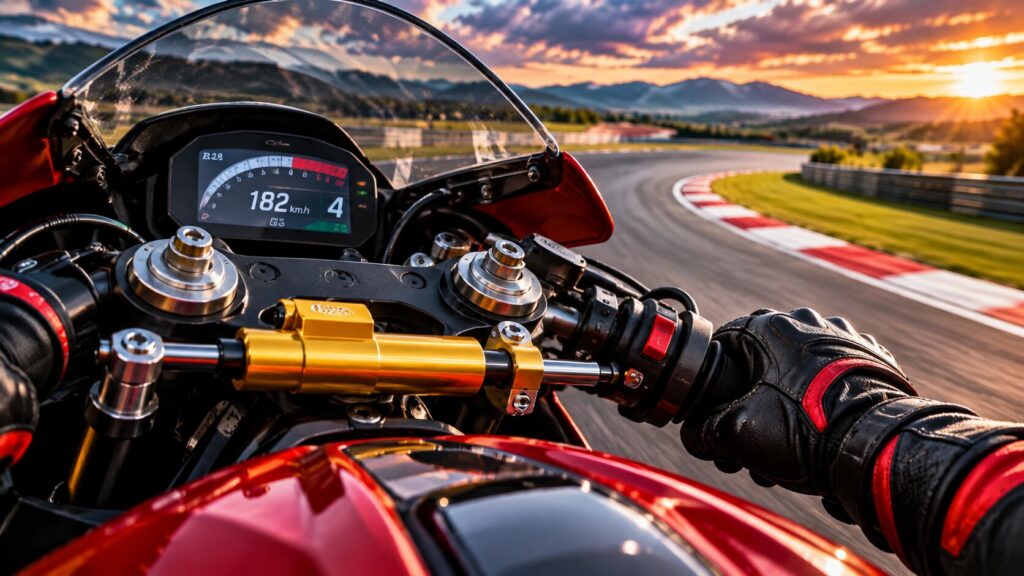
Most conventional steering dampers use hydraulic resistance to control rapid steering movements. A piston moves through a cylinder containing hydraulic fluid, with internal passages regulating the flow of oil as the handlebars turn. Faster movements generally encounter greater resistance than slower, deliberate steering inputs.
A motorcycle steering damper connects the moving steering assembly to a fixed mounting point on the motorcycle. When an unexpected force acts on the front wheel, the damper dissipates some of the energy associated with the movement. This reduces the severity of steering oscillations and helps the motorcycle settle.
Understanding Steering Oscillations in Racing
Steering oscillations occur when the front wheel and handlebars move repeatedly from side to side. During severe instability, these movements can develop into what riders commonly call a tank slapper. Such behaviour can result from several interacting factors, including motorcycle geometry, tyre condition, suspension settings and changes in front-wheel loading.
A motorcycle steering damper helps limit the rapid movements associated with these disturbances. This becomes particularly valuable when the front wheel returns to the track after becoming unloaded during acceleration. However, damping cannot eliminate every form of instability or compensate for mechanical faults.
Five Benefits of a Motorcycle Steering Damper
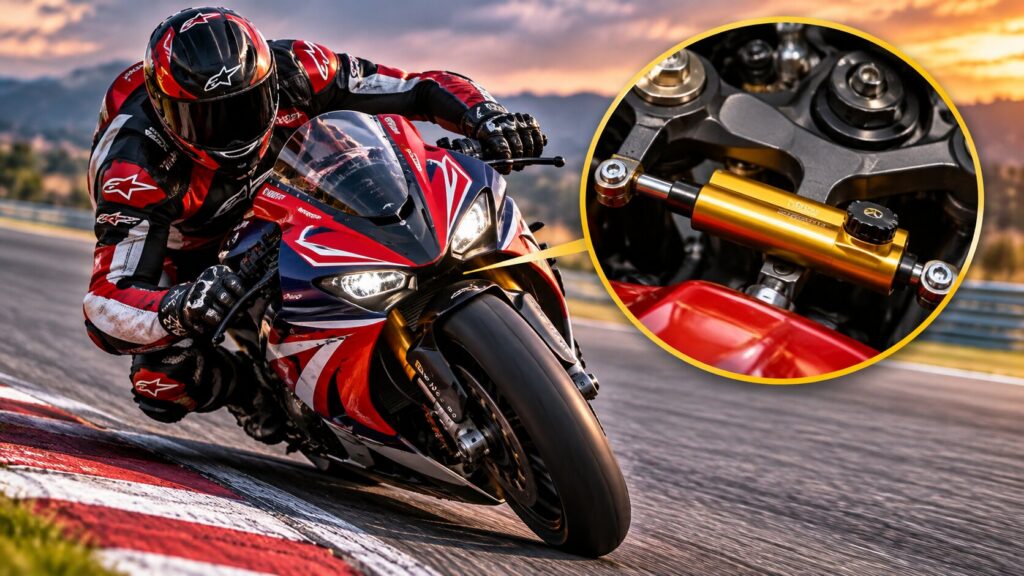
Racing teams consider steering stability an important part of overall motorcycle development. Effective damping allows engineers to manage unwanted movements while preserving the responsiveness required for competitive performance. The benefits extend across multiple sections of a racing circuit.
- High-Speed Stability: Reduces sensitivity to sudden steering disturbances on fast sections of the circuit.
- Controlled Acceleration: Helps manage unwanted handlebar movements when the front wheel becomes lightly loaded.
- Consistent Cornering: Supports predictable steering behaviour when riders encounter uneven surfaces.
- Reduced Rider Fatigue: Can decrease the physical effort associated with managing repeated steering disturbances.
- Improved Rider Confidence: Provides more predictable feedback when riding close to competitive limits.
These advantages depend on correct installation and appropriate damping settings. Excessive resistance can make directional changes more difficult, while insufficient resistance may provide inadequate control. Finding a suitable balance remains an essential part of race preparation.
Motorcycle Steering Damper Adjustment for Different Circuits
Different racing circuits place different demands on steering performance. Tracks featuring long straights and uneven surfaces may require different damping characteristics from circuits dominated by tight corners and rapid directional changes. Engineers must consider these conditions alongside the motorcycle’s suspension and chassis configuration.
Adjustable steering dampers allow teams to modify resistance according to rider feedback and manufacturer recommendations. During practice sessions, riders can evaluate whether changes improve stability without compromising their ability to steer accurately. Adjustments should form part of a coordinated setup process rather than being used to conceal underlying handling problems.
Electronic Steering Damping Technology
Electronic steering damping introduces another level of adaptability to motorcycle performance. Instead of maintaining a single manually selected damping characteristic, compatible systems can modify resistance according to information received from onboard sensors. This allows the system to respond to changing riding conditions.
An electronic motorcycle steering damper can use information such as speed and acceleration to influence its operation. Manufacturers such as Öhlins have developed electronically controlled systems alongside conventional adjustable designs. These technologies illustrate how motorcycle engineering continues to balance mechanical performance with intelligent electronic control.
Working With Other Motorcycle Racing Technologies
Steering damping represents only one part of a motorcycle’s performance package. Technologies such as motorcycle launch control help manage acceleration from the starting grid, while suspension systems influence weight transfer and wheel contact. Each component contributes differently to the behaviour of the machine.
Tyre preparation is equally important when evaluating motorcycle stability. Racing teams use motorcycle tyre warmers to prepare tyres for track conditions, while monitoring pressures and temperatures throughout competitive sessions. Combining suitable tyre preparation with correct chassis settings creates a stronger foundation for effective steering damping.
Balancing Racing Stability With Steering Responsiveness
The ideal motorcycle steering damper setup supports stability without making a motorcycle unnecessarily difficult to manoeuvre. Racing riders require precise feedback when entering corners, changing direction and accelerating towards the next section of the circuit. Maintaining this balance allows damping technology to complement rather than restrict the rider’s control.
As motorcycle engineering continues to develop, steering stability remains an important consideration in competitive machine design. From conventional hydraulic components to electronically controlled systems, damping technology demonstrates how relatively compact components can influence overall handling. Explore our Bike Racing articles for more insights into the engineering behind competitive motorcycle performance.